
Inside Out: The Physical and Sensory Architecture of Brain Development
Early in my teaching career, I faced a true trial by fire: a kindergarten classroom of fifteen energetic boys and only five girls. Traditional pedagogy tells you to manage this with tighter carpet rules, color-coded behavior charts, and highly structured indoor routines. Fortunately, I was at a charter school situated on 55 acres of land with an explicit expectation that our classes be outside for far more than just standard recess.
I quickly realized that trying to force twenty five-year-olds to sit in a tight indoor circle first thing in the morning was a recipe for collective dysregulation. The solution wasn't a better indoor behavior plan; it was removing the physical barriers entirely.
Most mornings, we set our day up for success by conducting our morning meeting via a rugged, nearly two-mile hike. We traversed trails that wound up, down, and through a deep ravine. We stopped along the trail to run our greeting, sharing, and complete a group activity before ever heading back to the classroom for our morning message. When we finally sat down for our indoor tasks, the children were focused, grounded, and profoundly regulated. The fresh air, natural lighting, and sheer expanse of space had an organic, calming effect that no indoor tool could match.
This became my ultimate teaching lesson, a phrase coined by the late outdoor educator Erin Kenny:
“Children cannot bounce off the walls if we take away the walls.”
In my early childhood enrichment program, Wonderwend Hollow, we live by this truth. We prioritize incorporating at least an hour of entirely child-led play outdoors. When you remove the walls and give children true freedom, they don't descend into chaos. They step into their own physical identities: climbers, builders, and muddy explorers. They instinctually know exactly what their bodies need to regulate, but all too often, modern environments and well-meaning adults step in and stop the process.
To understand why this works, we have to look first at how the human body is physically wired to grow.
Physical Foundations: Proximodistal and Cephalocaudal Trends
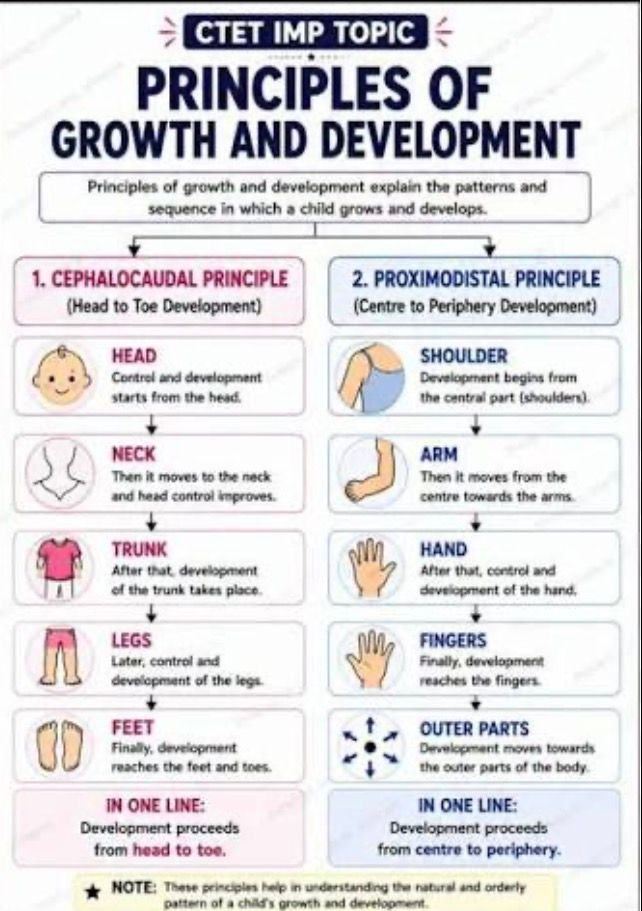
Human motor development is governed by two fundamental directional principles: proximodistal development (growth and control from the center of the body outward) and cephalocaudal development (growth and control from the head downward).
Understanding these physiological blueprints reveals why rushing fine motor academic tasks in early childhood works directly against a child's natural anatomy.
The Proximodistal Trend (Center to Outward)
A child cannot master fine motor skills—such as the precise hand movements required to hold a pencil, use scissors, or tie shoes—without first building gross motor stability in their core, trunk, and shoulder girdle. Control moves systematically from the midline of the body, to the shoulders, to the elbows, to the wrists, and finally to the fingertips.
The Cephalocaudal Trend (Head to Toe)
Parallel to proximodistal growth, physical control unfolds from top to bottom. A child gains postural control over their head, neck, and upper torso long before they can stabilize their hips, legs, and feet.
We see these dual directional maps unfold from the very beginning of life:
- Tummy Time: Combines cephalocaudal and proximodistal growth by building the extensor muscles in the neck, upper back, and core, while putting weight through the hands to form the physical arches of the palms.
- Sitting & Crawling: Crawling forces direct weight-bearing through the shoulder girdle and wrists—stabilizing the joints that will later serve as the physiological anchor for writing—while requiring lower-trunk stability. It is also a child's first major experience with bilateral coordination and crossing the body's midline.
- Walking, Running, Jumping, Hopping, Galloping, & Kicking: As cephalocaudal control reaches the lower extremities, these dynamic movements require rapid shifts in gravity, deep core activation, and systemic bilateral coordination.
- Skipping, Riding a Bike, Swimming, Throwing, & Catching: These represent advanced motor integration. They require the ultimate coordination of the extremities, multi-joint control, and rapid communication across the midline while maintaining a locked-in, stabilized core.
Why Earlier Isn't Better: The Anatomy of a Young Hand
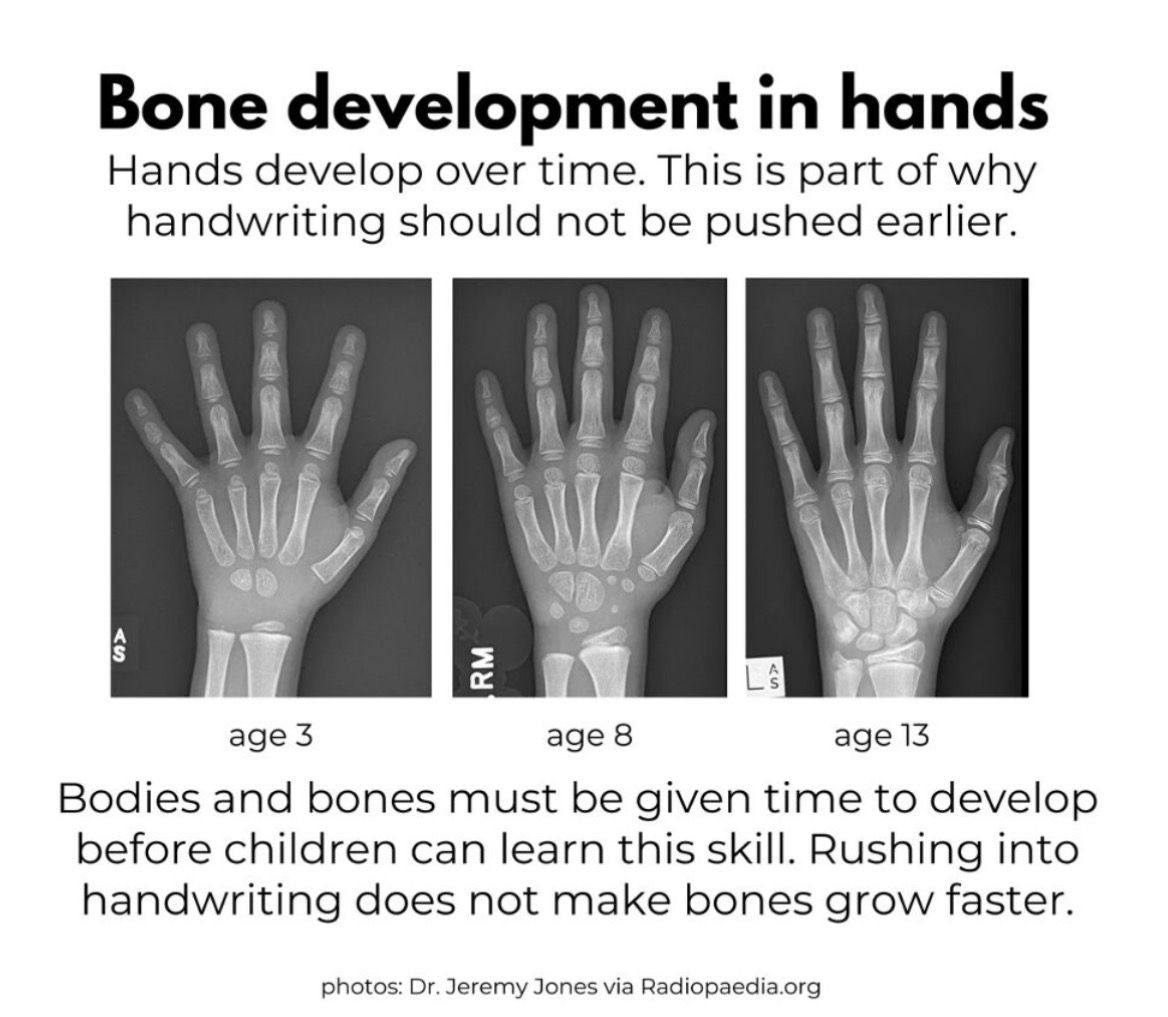
When we rush young children into indoor desks to practice handwriting before these proximodistal and cephalocaudal progressions are consolidated, we are literally fighting their anatomy.
At age five or six, a child's hand is not physically fully formed. The wrist and hand of a young child are primarily made of cartilage; the eight carpal bones of the wrist do not fully ossify (turn to bone) until around age six or seven, and the process isn't completely finished until puberty. Forcing a child to grip a pencil and practice repetitive, fine motor writing before their hands have structurally developed the bones, muscles, and ligaments to support it leads to hand fatigue, awkward grips, and deep frustration.
When it comes to pencil grips and worksheets, earlier is not better. Building hand strength starts with climbing trees, hanging from branches, and digging in the earth.
The Physical Development of the Eyes
It’s not just hand bones that aren't ready for early desk-work; their eyes aren't either. To read and track text across a page from left to right, a child’s eyes must be able to smoothly track horizontally without losing focus. The ocular muscles that control eye tracking and dynamic depth perception are built by looking across wide distances, tracking wind-blown leaves, following insects in the dirt, and navigating terrain while running through a forest. Staring at flat, close-up worksheets or screens under fluorescent lights starves these delicate muscles of the dynamic exercise they need to mature.
Uncurating the Senses: The Internal Sensory GPS
This physical development is directly fueled by our sensory systems—and we have more than the traditional five (sight, hearing, smell, taste, and touch). Our bodies rely heavily on three hidden, internal systems that act as our neurological anchors:
- The Vestibular System (Balance & Spatial Orientation): Located within the fluid-filled canals of the inner ear, this system tracks gravity, direction, speed, and changes in head position. It tells us where our head is in space.
- Examples: Developed when kids spin in circles, roll down grassy hills, hang upside down, swing, and tilt their bodies out of an upright position.
- The Proprioceptive System (Force, Pressure, & Resistance): Located in our muscles, joints, and ligaments, this system processes deep pressure, mechanical tension, and physical resistance. It registers exactly how much force or effort our muscles are exerting during "heavy work."
- Examples: Developed when kids lift heavy logs, push against thick mud, pull loaded wagons, climb, and engage in rough-and-tumble play.
- The Interoceptive System (Internal State): This reads internal bodily cues like heart rate, respiration, hunger, thirst, temperature shifts, and the physical urgency of bladder and bowel fullness (voiding and defecating).
- Examples: Developed when kids feel cold as the wind picks up, recognize when they actually need to use the restroom before it is an emergency, feel their hearts race as they climb a steep hill, and learn to map these raw physical sensations to a bodily need. (Note: This is one of the reasons why so many modern children struggle with potty training—they are environmentally disconnected from their own internal interoceptive radar).
Oral Proprioception: Breastfeeding, Pacifiers, and Co-Regulation
To understand how deeply young children crave this physical resistance, we only have to look at the oral motor system. The jaw joint (the temporomandibular joint) is one of the most receptor-dense joints in the human body. Sucking, biting, and deep jaw work provide localized oral proprioceptive input—a direct, neurological lever that instantly down-regulates a dysregulated nervous system.
In infancy and toddlerhood, breastfeeding is nature's primary vehicle for this sensory co-regulation. Unlike drinking from a cup, nursing requires significant muscular exertion from the jaw, face, and tongue, pressing against the hard palate and sending a flood of calming proprioceptive feedback straight to the brain.
Organizations like La Leche League International have long championed the emotional and developmental benefits of toddler nursing and child-led weaning. When a child is allowed to guide the weaning process, they naturally phase out nursing as their gross motor and systemic proprioceptive systems mature. Their nervous system gradually shifts from relying on oral co-regulation to utilizing full-body movement for self-regulation.
The Cultural Misconception Around Weaning
A common point of confusion for modern parents is the timing of weaning. While pediatric guidelines advise transitioning away from artificial bottles around age one to protect dental alignment and oral structure, parents often mistake this as a directive to stop breastfeeding altogether. In reality, the American Academy of Pediatrics (AAP) updated its official stance to recommend continued breastfeeding for two years and beyond, explicitly citing the ongoing developmental, emotional, and sensory benefits for the growing child.
When weaning is abruptly forced before a child’s nervous system is ready—or when breastfeeding is cut short without providing alternative sensory outlets—children will naturally seek out compensatory oral input. This often manifests as extended pacifier dependence, thumb sucking, chewing on shirt collars, biting nails, or grinding teeth.
Solving the Sensory Need
When parents try to eliminate a pacifier or force an abrupt weaning process, they are often met with intense behavioral pushback. They aren't just being stubborn; their nervous system is desperately seeking the jaw-stabilizing input it relies on for regulation.
Standard advice often focuses solely on oral substitutions: drinking thick smoothies through tiny straws or chewing on highly resistant foods. While these tools do provide oral resistance, relying heavily on sweet snacks introduces a sugar load that triggers behavioral spikes and dental concerns.
The true secret to supporting a child through weaning—and helping them release pacifier dependence—is filling the entire body’s proprioceptive bucket. Engaging a child in full-body "heavy work"—climbing trees, hanging from monkey bars, carrying heavy buckets of dirt, and pushing loaded wagons—provides a systemic flood of deep pressure. When a child's entire body is structurally grounded and regulated through physical resistance, the hyper-focused neurological craving for oral soothing naturally fades.
The Neurological Engine: How Movement Drives Brain Development
Once the body and sensory systems receive the raw physical inputs they crave, the cognitive and neurological benefits naturally unlock. Whole-body movement isn't a break from learning; it is the engine of learning.
As pediatric occupational therapist Angela Hanscom notes in Balanced and Barefoot:
"The more exposure your child has to sensory experiences throughout the day, the more integrated and organized the brain, senses, and body become."
The deep connection between motion and cognition operates on key neuroscientific principles:
- Somatic and Embodied Cognition: Traditional educational models treat the brain as an isolated processor and the body as a passive vehicle. However, research in cognitive science shows that the mind and body operate as a single, unified system (Shapiro, 2019). Physical actions, gestures, and tactile interactions with the environment create cognitive "memory tags". When a child learns a concept while physically navigating space, the memory is encoded far more deeply than through passive, stationary listening (Glenberg, 2010).
- Cerebral & Cortical Stimulation: Physical motion directly stimulates the cerebellum—the brain region responsible for balance and motor control, which neuroscientists now know is also highly active during cognitive processing and information synthesis (Buckner, 2013). Active play increases systemic blood flow, triggers the prefrontal cortex (the seat of focus and executive functioning), and stimulates the hippocampus, which is critical for memory consolidation (Ratey, 2008).
- Stress Alleviation: Prolonged, sedentary sitting builds physiological tension and elevates cortisol levels. Movement serves as a neurological circuit breaker, actively lowering anxiety, balancing the endocrine system, and resetting attention spans so the brain is receptive to new information (Jensen, 2005).
- Sensory Integration: Engaging multiple sensory pathways concurrently—such as physically walking while practicing language or rhythmically moving while counting—keeps the central nervous system engaged and dramatically improves information retention (Ayres, 2005).
Understanding Neuroplasticity
At the core of this brain-body connection is neuroplasticity—the brain’s ability to structurally reorganize itself by forming new neural pathways in response to physical experiences. Think of the brain like a dense forest. When a child learns a new skill, they carve out a tiny foot trail through the brush. The more they practice that skill, the wider, smoother, and more permanent that trail becomes, eventually turning into a paved highway.
For example, when a child climbs a tree, their brain is rapidly firing to calculate depth, muscle force, balance, and spatial awareness all at once. This multi-sensory, real-time feedback loop forces the brain to build highly complex, cross-connected neural pathways that make future academic learning easier and more efficient.
Disability vs. Lack of Exposure
Today, millions of children are being flagged as having sensory differences, behavior challenges, or attention deficits. But we need to look closer and ask: What is the major roadblock?
To be clear, neurodevelopmental disabilities are real, valid, and require genuine support, accommodations, and clinical care. Going outside does not "cure" a clinical disability. However, we must distinguish between true neurodevelopmental conditions and an environmentally induced lack of exposure. The roadblock in many curated classrooms isn't always an organic deficit within the child; often, it is a deficit in the modern, restricted environment that artificially produces or exacerbates sensory dysregulation.
On average, the modern child spends the vast majority of their waking hours—from infancy through age 18—confined to indoor, curated environments.
And look at the paradox of these indoor spaces: they are physically "flat" (depriving the body of movement), yet visually distracting and overstimulating. Classrooms are frequently filled with harsh fluorescent lighting, bright neon colors, and walls cluttered with posters, which actively overwhelms their visual systems while their physical bodies are starved of input.
Consider this: Chip Wood’s prominent developmental guide, Yardsticks: Child and Adolescent Development, has actually added "falling out of chairs" to the list of typical physical behaviors to expect for five and six-year-olds.
Rather than treating a child’s inability to sit upright as a symptom of a weakened vestibular system and demanding we fix the environment, mainstream education is changing the child development milestones to fit the curated, sedentary environment.
Because of this systemic lack of exposure, pediatric occupational therapists are now seeing children who literally need therapy to tolerate a gentle breeze on their faces or to learn how to walk on uneven ground, simply because they have been kept inside.
Are We Pathologizing Normal Development?
When we confine children to environments that restrict basic physical milestones, typical biological bids for movement begin to look like behavioral issues. As a result, we risk pathologizing natural human development rather than addressing environmental deprivation.
- The Actual Numbers: Research indicates that between 5% and 16.5% of typically developing children experience significant sensory processing differences.
- The Scale: With roughly 50 million school-aged children in the United States, this means 2.5 to 8 million children are navigating school with sensory differences.
The Sensory Table Conundrum: The Capitalization of Play
This brings us to one of the biggest modern educational and parenting trends: the elaborate, highly curated indoor sensory table filled with dyed rice, water beads (never use these as they can be fatal if swallowed), or rainbow-colored pasta.
While these bins can serve as a targeted clinical tool for specific occupational therapy needs, they represent capitalism at its finest. We have successfully commodified sensory play, packaging a tiny, sanitized sliver of the tactile world into a neat plastic container that fits a clean, managed indoor aesthetic.
The sensory table is the micro-siloing of an experience. Standing still and sifting dyed rice through fingers isolates the tactile sense in the small joints of the hand, but it leaves out the rest of the body. It offers zero vestibular input, zero core activation, and zero heavy proprioceptive work.
Nature's Perfect Sensory Integration: Uncurated and Free
The best, most profoundly regulating sensory experiences are 100% free. A child playing on an uneven, natural beach or digging in a muddy backyard—where wet earth provides deep physical resistance, the wind shifts against their skin, waves challenge their balance, and lifting mud requires full-body leverage—is experiencing an integrated, holistic sensory experience that no plastic table can ever match. Nature doesn't need to be curated into a bin. It is already the ultimate sensory experience.
Emotional Regulation & Bilateral Stimulation
Rhythmic, cross-lateral physical activities like running, swimming, and riding a bike require bilateral coordination—the ability to use both sides of the body together in a controlled manner. Crossing the body's midline forces the left and right hemispheres of the brain to communicate rapidly via the corpus callosum.
In clinical psychology, frameworks like EMDR (Eye Movement Desensitization and Reprocessing) utilize alternating bilateral stimulation (like rhythmic tapping or side-to-side eye movements) to down-regulate a stressed amygdala and calm a hyper-reactive nervous system. Rhythmic running or biking acts as nature's EMDR, lowering cortisol, releasing dopamine, and triggering that peaceful "runner's high" that naturally regulates emotions.
Recently, the digital world has tried to replicate this somatic phenomenon through the latest audio trend: 8D audio tracks. When listened to with headphones, 8D audio uses panning mixing techniques to create a sweeping, left-to-right acoustic effect. Neurodivergent communities often describe this sensation as "brain flossing"—an auditory form of bilateral stimulation that clears out mental overstimulation. But while 8D audio is a clever tool, it is just a digital mimic of what physical, cross-lateral movement does naturally and holistically.
The Microbiome, Vitamin D, & Myopia
The physical benefits of being outside go deep into our biology. Playing in dirt exposes children to healthy soil microbes, which actively strengthens their gut microbiomes and immune systems. Sun exposure provides essential Vitamin D, which regulates sleep cycles and bone density. Furthermore, pediatricians are seeing a massive spike in childhood myopia(nearsightedness) because children do not spend enough time in natural sunlight, which is biologically required to help the eye shape itself correctly during growth.
The Barrier of Safety: Embracing Healthy Risk
Even when we understand the physical necessity of movement and the unmatched sensory power of the outdoors, a powerful roadblock often stops us from letting children fully engage: our modern obsession with safety. In our effort to protect children, we have inadvertently created environments that starve their bodies of the very inputs they need to remain secure.
"Safer" is Often More Dangerous
We live in a culture obsessed with "safety first," but this hyper-vigilance actually makes our children less safe. Angela Hanscom notes that due to a lack of core strength, balance, and coordination, modern children are becoming increasingly accident-prone.
When we prevent children from climbing trees, walking on log walls, or taking calculated risks, we prevent them from developing their vestibular and proprioceptive systems. They literally lose their balance, fall more often, and fail to develop the spatial judgment needed to keep themselves safe.
Modern playgrounds have been stripped of the very things that once built children's sensory systems. Because of a highly litigious society and helicopter parenting, we have seen the systematic removal of merry-go-rounds, high swings, tall teeter-totters, and challenging jungle gyms—the exact tools that historically provided deep vestibular and proprioceptive input. By making environments artificially "safe," we make our children physically clumsy and far more vulnerable to injury.
The Playground Paradigm: Climbing Up the Slide
Go to any public playground, and you will inevitably hear a well-meaning adult scold a child with the standard rule: "Go up the stairs and down the slide!"
But I always want to ask: Why?
Is it genuinely dangerous? Not likely. Climbing up a slick, inclined plastic or metal surface forces a child to engage their core, dig in with their toes, pull with their upper body, and figure out how to work against gravity—a fantastic developmental and proprioceptive workout.
What it does disrupt is the neat, predictable order of a single-file line. But disrupting that line provides a brilliant, authentic opportunity for kids to problem-solve, navigate spatial boundaries, and communicate with one another ("Hey, I'm coming down!" "Wait until I get to the top!"). Children are remarkably capable of managing these spatial negotiations and self-regulating if we stop interfering.
End-of-the-Day Grounding: Rhythms to Regulate
Once we give children room to explore, move, and take healthy risks throughout the day, these same sensory principles apply when it's time to bring everything back down in the evening. Movement doesn't just prime the brain for learning—it also provides the physiological tools required to transition into rest.
I watched this exact biological reality unfold on my journey as a parent. My oldest has always been a constant mover and a doer, and we quickly noticed a distinct pattern: he had less need for sleep and long, drawn-out, dysregulated bedtimes. After diving deep into sensory frameworks, my husband and I realized he didn't need a quiet, sedentary wind-down; he needed heavy proprioceptive input and bilateral stimulation to signal his nervous system to rest.
This became a beloved nightly rhythm: a high-energy wrassling match with my husband, where "The Big Kahuna" is his official stage name (and our kids proudly play the roles of "Big Kahuna Slayer" and "Little Kahuna"). This intense, playful rough-and-tumble wrassling provides the exact heavy work his proprioceptive system craves.
We follow up this heavy physical work with a bath and a family favorite: Bubble Mountain. We bring a bowl and a straw into the tub, fill it with water and liquid soap, and let him blow a giant mountain of bubbles. While blowing bubbles isn't heavy work, the resistance of blowing through that straw forces slow, deep, diaphragmatic breathing—the precise physiological trigger required to activate the parasympathetic nervous system, transition out of fight-or-flight, and bring the body to a state of rest.
Move to learn
There is an erroneous modern assumption that physical development and academic learning are separate tracks—that if a child is moving, they aren't achieving academic readiness. The opposite is true. Unstructured, child-led outdoor play is the absolute prerequisite for higher-level academics:
- Reading & Literacy: Built on visual tracking developed by watching moving leaves, following insects, and coordinating the left-to-right eye movement that crossing the midline strengthens.
- Mathematics & Spatial Awareness: Grounded in geometry and physics calculated when kids balance logs, jump across creeks, and experience weight and volume in the physical world.
- Science & Social Studies: Experienced firsthand in nature's living laboratory by observing processing, gravity, friction, and the weather.
- Language & Communication: Developed when children are given uninterrupted hours to negotiate complex, multi-layered play schemes, solve problems, and express ideas with peers.
As Maria Montessori famously observed:
“Movement, or physical activity, is an essential factor in intellectual growth, which should not be separated from mental activity.”
We challenge you to begin the day with physical movement. This is not just a tool to prime the brain for academics; it is a healthy, lifelong habit that teaches children how to self-regulate and care for their physical well-being.
For children in kindergarten and under, our advice is simple: reduce the curriculum and increase the outside play.
Instead of asking yourself, "What is the best curriculum for my young child?" shift your focus to their physical playground. Ask yourself:
- What natural outdoor features can I add to my yard?
- What loose parts—like loose wood planks, crates, or a big collection of acorns and pine cones—do my children enjoy sorting and moving around?
- Where can I get a manual water pump or a pile of pea gravel for endless, heavy-work play?
If we want our children to truly understand the world, we have to involve their entire bodies in it. We have to drop the walls and trust their biology.
But what actually happens to a child's brain, development, and essence when we step out of the way and let them play? Next week, we are going to dive deep into the science of child-led play, explore the groundbreaking work of play pioneer Dr. Stuart Brown, and look at what play actually is—and why it is a biological necessity on par with sleep.
Citable Research
Ahn, R. R., Miller, L. J., Milberger, S., & McIntosh, D. N. (2004). Prevalence of parents’ perception of sensory processing disorders. American Journal of Occupational Therapy, 58(3), 287-293.
American Academy of Pediatrics (AAP). (2022). Policy statement: Breastfeeding and the use of human milk. Pediatrics, 150(1), e2022057988.
Ayres, A. J. (2005). Sensory integration and the child: 25th anniversary edition. Western Psychological Services.
Buckner, R. L. (2013). The cerebellum and cognitive function: 25 years of insight from anatomy and neuroimaging. Neuron, 80(3), 807-815.
Glenberg, A. M. (2010). Embodiment as a unifying perspective for cognitive science. Wiley Interdisciplinary Reviews: Cognitive Science, 1(4), 586-596.
Hanscom, A. J. (2016). Balanced and barefoot: How unrestricted outdoor play makes for strong, confident, and capable children. New Harbinger Publications.
Jensen, E. (2005). Teaching with the brain in mind (2nd ed.). Association for Supervision and Curriculum Development.
La Leche League International (LLLI). (2020). The womanly art of breastfeeding (8th ed.). Ballantine Books.
Ratey, J. J. (2008). Spark: The revolutionary new science of exercise and the brain. Little, Brown and Company.
Shapiro, L. (2019). Embodied cognition. Routledge.